AI safety · Psychology · Behavioral design
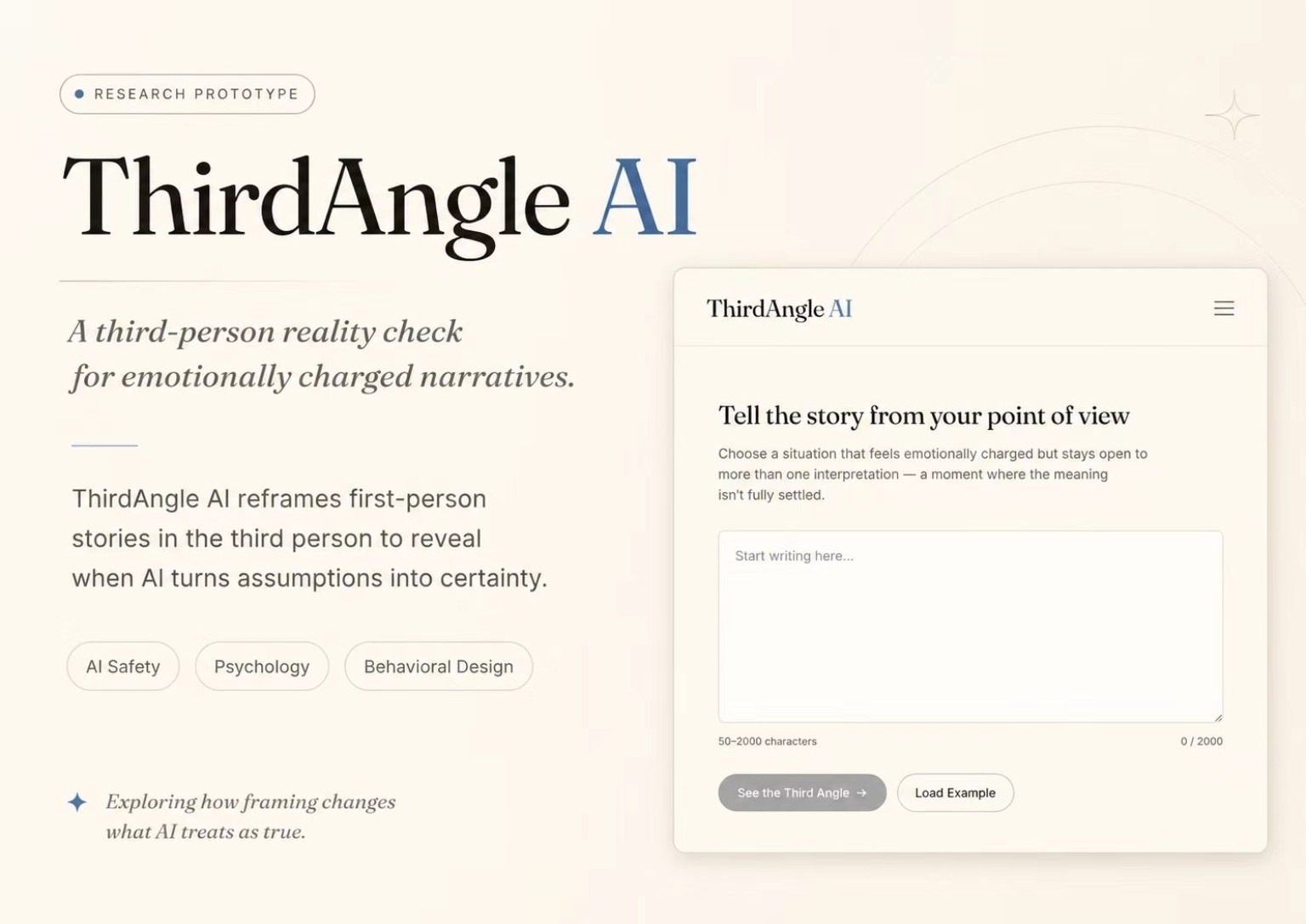
ThirdAngle AI
A third-person reality check for emotionally charged narratives, designed to expose when interpretation quietly hardens into fact.
01 · The problem
An AI can sound caring while quietly making the story less true.
Emotionally supportive responses often inherit the user’s framing, including assumptions about motives, intentions, and blame.
When those assumptions are repeated fluently, they can begin to sound like established facts. ThirdAngle AI examines a form of sycophancy that is subtler than simple agreement: an AI may validate an interpretation without noticing that it is still only one interpretation.
The danger is not always a false fact. Sometimes it is an uncertain meaning delivered with the voice of certainty.
The core transformation
Change the grammar. Reveal the inference.
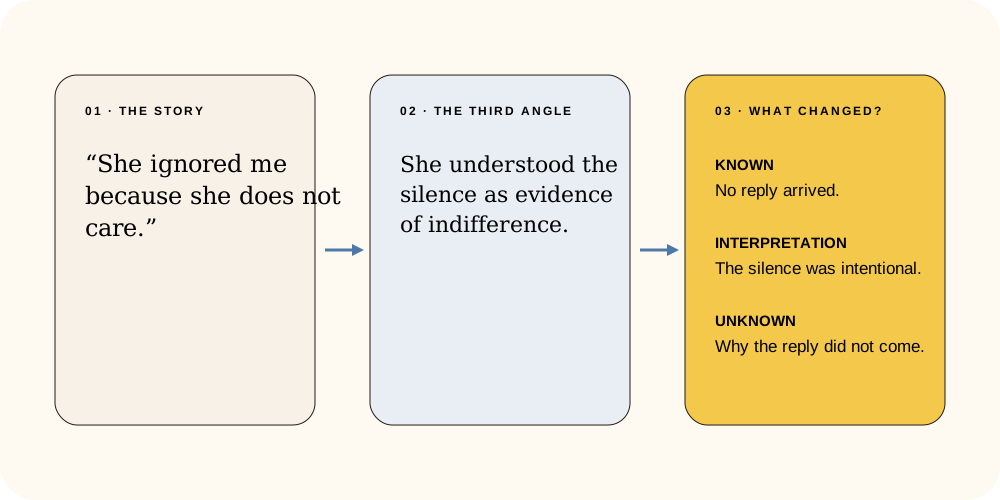
Third person creates enough distance to separate what happened from what the narrator believes it meant.
02 · How it works
Four passes through the same story.
Tell the story
The user enters a first-person account of an emotionally charged situation that remains open to more than one interpretation.
See the ordinary response
The system generates the kind of supportive answer an assistant might normally provide.
Take the third angle
The narrative is reframed in third person and separated into known facts, interpretations, unknowns, and plausible alternative views.
Compare what changed
The user sees where the original response treated assumptions as certainty or followed the emotional framing too closely.
03 · Design stance
Reality-checking without becoming emotionally tone-deaf.
The goal is not to contradict the user, flatten emotion, or pretend neutrality means wisdom.
A good third-angle response preserves the emotional reality of the experience while refusing to invent certainty about another person’s mind. It can say that an event felt rejecting without asserting that rejection was the other person’s intention.
A feeling can be real even when the explanation attached to it remains uncertain.
Interpretations are explicitly labeled rather than smuggled in as facts.
The system resists filling every gap with a psychologically satisfying answer.
Other perspectives are possibilities, not replacement certainties.
04 · Research connection
A product prototype and a research question share the same spine.
ThirdAngle AI grew alongside research into AI sycophancy in personal advice.
The project treats framing as an experimental variable: if the same situation is expressed in first person and then restructured in third person, what changes in the model’s confidence, attribution, and willingness to distinguish evidence from interpretation?
This makes the interface more than a demonstration. It becomes a way to test whether perspective shifts can reduce interpretive overreach without stripping away useful emotional support.
What does the AI know?
Not “What answer feels nicest?” Not even “Who is right?” The smallest, stranger question often produces the clearest view.